
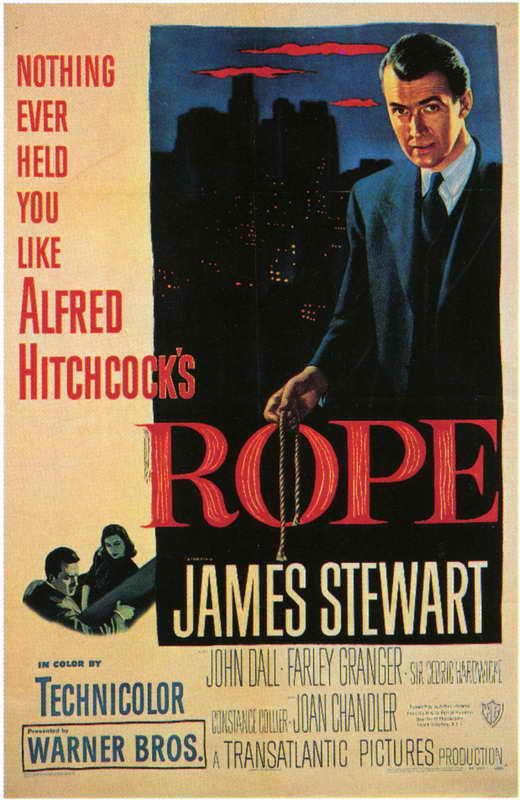
Figure 1: Film Poster.
Rope (1948) is an American thriller film directed by Alfred Hitchcock. The film is based on the play Rope (1929) by Patrick Hamilton. The film is the first of Hitchcock’s Technicolor films and it takes place in real time by continuous long shots edited together to appear like a continuous shot. The film is about two young men Brandon and Phillip who have murdered their former classmate David. They want to prove themselves that they can commit the “perfect murder”.

Figure 2: Phillip and Brandon killing their friend David.
The hint of the person who has been murdered and hidden in a large wooden chest box is given to the audience by the very earl start of the film. The director does not hold any information from the audience. Although the fact that you know everything right from the beginning the movie with its techniques suspense you until the end. The two men are hosting a dinner party where they have invited the friends and the family of David. His father, his fiance and his aunt are in the dinner. Also their former teacher Rupert is invited. They have put the dead body of David in a wooden chest box where in top of it are the snacks and the food for the dinning party. This according to Brandon who is the strongest character of them two and he is dominating Phillip is the perfect murder where no one will suspect them. Rope depicts the homosexuality of the men, but because at the time it was filmed it was unable to praise such ideas and matters Hitchcock decided to put them in an indirect way in his film. “Hitchcock was, at the time, unable to raise such things directly, he presents us with a relationship between Brandon and Philip that is almost certainly romantic in nature.” (Kermode, Unknown). I will have to admit that the dialogues in the film didn't surprise me and in general the plot didn't move my interest. Although Hitchcock wanted to focus more in the real time of shooting the film and the theatricality of the scenes. “In "Rope," Hitchcock is less concerned with the characters and their moral dilemmas than with how they look, sound and move, and with the overall spectacle of how a perfect crime goes wrong.” (Canby, 1984). The film has some parts where tension and suspense is being achieved by little things. Especially in the scene where Rupert questions Phillip in the dinning party about the chest box and the rope, by enabling the metronome on the piano where Phillip sits. It achieves the effect of suspension which drags the audience more into the film.

Figure 3: Scene where Rupert questions Phillip and tension is achieved.
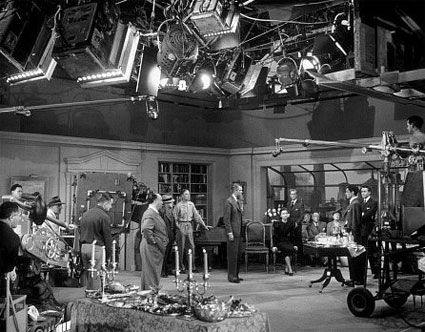
The film is taking place in one particular set. Brandon’s apartment. Each shot is approximately 10 minutes and the change of the camera’s film is being achieved by panning into people’s back which indicates the change of the film. The effect of being in a real-time movie makes the film very theatrical. “Far from just "recording a play," the suffocating long takes enforce ethical contemplation by refusing the relief of a cut (which, in the director's voyeuristic world, would have amounted to looking the other away)”.(F.Croce, 2006). Hitchcock by having the long shots he embraces the realism of the scenes and the theatricality of the film.

Figure 4: The set of the film.
In the end where everyone has left the party except Rupert where he discovers the hat of David, and he sees the guiltiness in the eyes of the two men. He uncovers the crime they have
Illustration List:
Figure 1: Rope (1948) Film Poster.
(Accessed: 14/2/2012).
Figure 2: Rope (1948) Phillip and Brandon killing their friend David.
(Accessed: 14/2/2012).
Figure 3: Rope (1948) Scene where Rupert questions Phillip and tension is achieved.
(Accessed: 14/2/2012).
Figure 4: Rope (1948) The set of the film.
(Accessed: 14/2/2012).
Bibliography:
Kermode, Jennie. (Unknown), Rope (1948) Film Review.
(Accessed: 14/2/2012).
F.Croce, Fernando. (2006), Rope (1948) Film Review.
(Accessed: 14/2/2012).
Canby, Vincent. (1984), Rope (1948) Film Review.
(Accessed: 14/12/2012).



No comments:
Post a Comment