
Figure 1: Film Poster.
Rear View (1954) is an American suspense film directed by Alfred Hitchcock. The film is based on Cornell Woolrich's 1942 short story "It Had to Be Murder". The film stars James Stewart as Jeff and Grace Kelly as Lisa Carol Fremont. The film is the one in which Hitchcock speaks about personalities. Also the film contains some Freudian ideas about personality. Jeff is a photographer who recently had an accident during a dangerous assignment in his work. His leg is broken and he is on a wheelchair. He spends most of his time in his apartment spying from his window by looking through his telephoto camera lens his neighbors and their actions.

Figure 2: Jeff spying his neighbors through his window.
The camera pans in the windows of the neighbors from Jeff’s point of view. “The camera, for almost the entire film, is kept in Jeff's apartment and seems to tell the story as if we were watching a silent film.” (Schwartz, 2005). The camera zooms to the other windows by only Jeff’s position. The panning into the other windows show different stories or different everyday situations of life.

Figure 3: Jeff's neighbor looking suspicious by cleaning a knife.
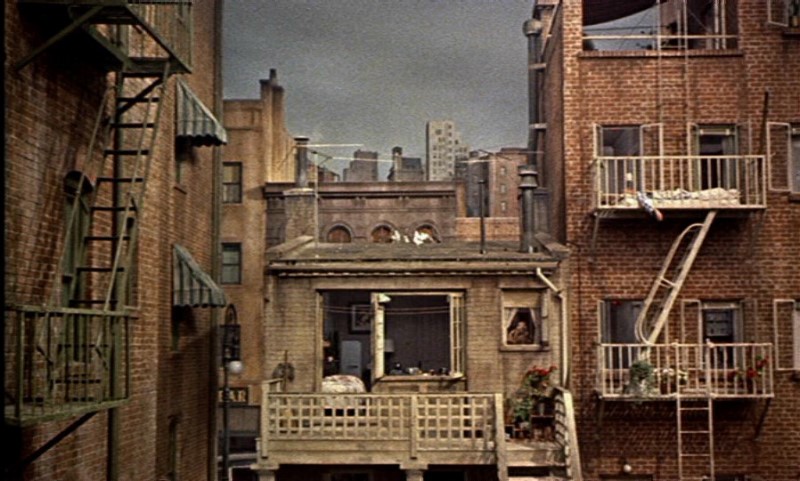
Everything is being filmed in one huge set and in general it is a very well-mannered film in terms of production. “All of the film's production elements are superior, especially the huge set, designed by Hal Pereira and built at the Paramount studio. It represents the best of studio artifice.” (Canby, 1983).

Figure 4: The set of the film.
His wealthy girlfriend Lisa and their insurance nurse Stella are “taking” action for him because he is immobilized in his wheeling chair due to his broken leg. The film shows the role of the man and women and how their relationship works. His wife and his nurse are going to search for the dead body of their neighbor into the courtyard. After his girlfriend being caught and having in her hands the ring of his neighbors dead wife in her hands his neighbor is being arrested after trying to kill Jeff by throwing him from the window.

Figure 5: Jeff being thrown by his window in the last scene.
The film suspense you slowly and smoothly until the end which makes it unique. There are some film techniques which make the film very cinematic. The quick cuts in the same shot to define expressions achieve the cinematic experience the film offers you. “Hitchcock considered Rear Window his "most cinematic" movie and, by way of explanation, paraphrased the famous Soviet montage experiment known as the Kuleshov effect: "Mr. Stewart is looking out into the courtyard and—let's say—he sees a woman with a child in her arms. Well, the first cut is Mr. Stewart, then what he sees, and then his reaction.” (Hobberman, 2000).
Illustration List:
Figure 1: Rear Window (1954), Film Poster.
(Accessed: 26/2/2012).
Figure 2: Rear Window (1954), Jeff spying his neighbors through his window.
(Accessed: 26/2/2012).
Figure 3: Rear Window (1954), Jeff's neighbor looking suspicious by cleaning a knife.
(Accessed: 26/2/2012).
Figure 4: Rear Window (1954), Figure 4: The set of the film.
(Accessed: 26/2/2012).
Figure 5: Rear Window (1954), Jeff being thrown from his window in the last scene.
(Accessed: 26/2/2012).
Bibliography:
Canby, Vincent (1983), Rear Window (1954) Film Review.
(Accessed: 26/2/2012).
Schwartz, Dennis (2005), Rear Window (1954) Film Review.
(Accessed: 26/2/2012).
Hobberman, J (2000), Rear Window (1954) Film Review.
(Accessed: 26/2/2012).




No comments:
Post a Comment