
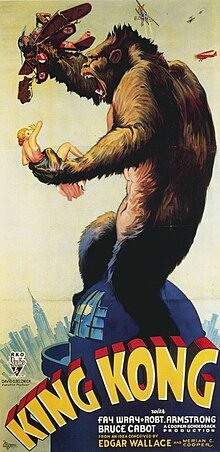
Figure 1: Movie Poster
King Kong (1933) directed by Merian C. Cooper and Ernest B. Schoedsack is fantasy monster adventure. The film tells of a gigantic island-dwelling ape-man creature called Kong who dies in an attempt to possess a beautiful young woman. This film reflects a particular view of Africa and race. It shows the white people’s view of Africa. The director had making the film in a way he wouldn’t interfere and offend stereotypes. “King Kong represents the American black, a creature who is taken forcibly from his homeland to America where he is exploited in chains but then breaks free and conquers New York. many young American blacks identified with Kong and conversely the film reflected white America’s fear of the black man.” (Honeybone, 2010)
In 1991, the film was deemed "culturally, historically and aesthetically significant" by the Library of Congress and selected for preservation in the National Film Registry because it was one of the first monster adventure movies. Even movies todays try to resemble it and approach it. ”…for decades after -- no monster movie (whether made in the U.S., Japan, or elsewhere) approached the lofty perch of this one” (Berardinelli, 1994)

Figure 2: Carl and Ann
The movie starts with Ann Darrow agreeing to star in a film directed by Carl Denham. Carl Denham takes his crew and Ann and set sail on the S.S. Venture for filming on a mysterious island in the Indian Ocean. During their sailing Ann falls in love with First Mate Jack Driscoll. The island they reached is full of natives who kidnap Ann and prepare her as a sacrifice to Kong. Kong is a huge apeman creature who dwells on the island. Kong take Ann to the jungle lair.

Figure 3: Ann kidnapped by natives
Driscoll and Denham take their crew and they go to the jungle to rescue her. In the jungle they face dinosaurs and other creatures they have to fight. Kong is distinguished for its stop-motion animation by Willis O'Brien and its musical score by Max Steiner.

Figure 4: Kong fighting with a dinosaur for Ann
Finally they take Ann back and they capture Kong with the help of some gas bombs. They are taking him back to New York to exhibit him with the aim of making money.

Figure 5: Kong captured and exhibited
The film contains some funny scenes. The technology and the special effects used in this film were cutting edge for the time that movie came out. Kong was made from aluminum, foam rubber, latex, and rabbit fur models. Kong's roars and grunts were created by manipulating the recorded roars of zoo lions. While he is exhibited in New York he breaks his chains escapes and takes with him Ann. He climbs to the empire state building and causes chaos. He tosses cars and battles with military airplanes. He takes one down but because of his wounds of the airplanes gunfire he falls to his death.

Figure 6: Kong on the Empire state building "fighting" with airplanes
The beast showed feelings and protective care for the beautiful blonde girl, who was horrified by the cruel treatment of the beast and much as by the death and devastation it caused.
Illustration List:
Figure 1: Merian C. Cooper and Ernest B. Schoedsack (1933) King Kong: Movie Poster
http://upload.wikimedia.org/wikipedia/commons/thumb/f/f3/Kingkongposter.jpg/220px-Kingkongposter.jpg
(Accessed 13/11/2011)
Figure 2: Merian C. Cooper and Ernest B. Schoedsack (1933) King Kong: Carl and Ann
(Accessed 13/11/2011)
Figure 3: Merian C. Cooper and Ernest B. Schoedsack (1933) King Kong: Ann kidnapped by natives
(Accessed 13/11/2011)
Figure 4: Merian C. Cooper and Ernest B. Schoedsack (1933) King Kong: Kong fighting with a dinosaur for Ann
(Accessed 13/11/2011)
Figure 5: Merian C. Cooper and Ernest B. Schoedsack (1933) King Kong: Kong captured and exhibited
(Accessed 13/11/2011)
Figure 6: Merian C. Cooper and Ernest B. Schoedsack (1933) King Kong: Kong on the Empire state building
(Accessed 13/11/2011)
Bibliography:
James Berardinelli (1994) King Kong Film Review
(Accessed 13/11/2011)
Nigel Honeybone (2010) King Kong Film Review
(Accessed 13/11/2011)
Laurie Boeder (2011) King Kong Film Review
(Accessed 13/11/2011)



No comments:
Post a Comment